
RSF-1 · CLUSTERED NAS
Highly Available Clustered NAS
Serve SMB, NFS and iSCSI from clustered ZFS pools. Shares, datasets and virtual addresses fail over together, so clients continue to reach the same endpoints after a node or network event.
How it works
RSF-1 manages the ZFS pool as a clustered service. A virtual IP (VIP) is bound to the pool. When the pool moves, the VIP moves with it. NFS, SMB and iSCSI services that use the pool are available on whichever node currently owns it.
Share configurations for NFS, SMB and iSCSI are created and managed entirely from the RSF-1 web interface. Once defined, the settings are automatically synchronised to every node in the cluster so that each node holds an identical copy of the share definitions. This ensures that when a pool fails over, the receiving node already has the correct configuration and can immediately present the same shares without manual intervention or configuration drift.
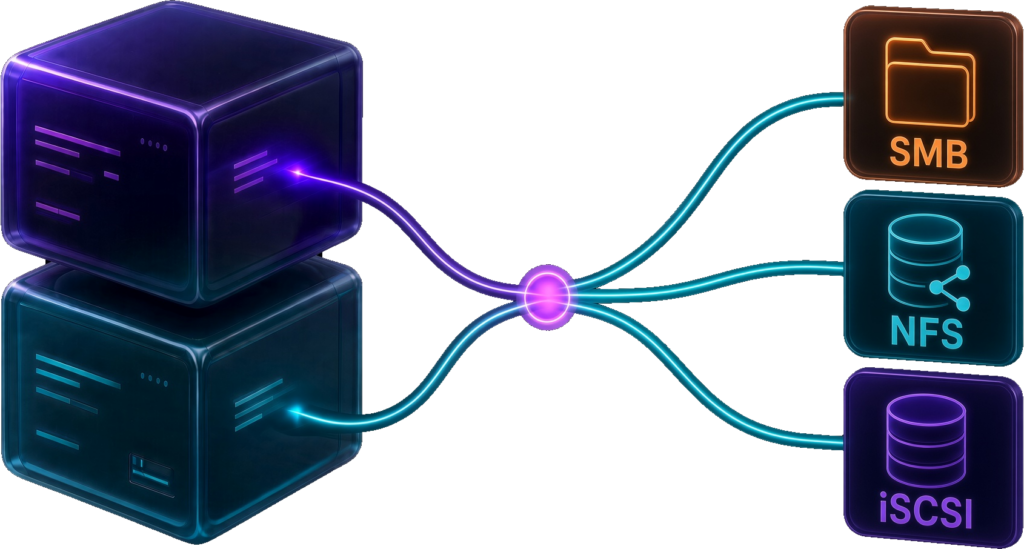
Clients connect to one or more virtual IPs (VIPs) associated with the pool. These VIPs can be configured on different interfaces or VLANs, allowing the same clustered pool to present services on multiple networks. The VIPs move with the pool, so clients continue to reach the shares through the same addresses after failover.
Active-active operation is fully supported. Each ZFS pool is treated as an independent clustered service, so different pools (together with their associated NFS, SMB or iSCSI shares) can run simultaneously on different nodes in the cluster. This allows the available compute and network resources of every node to be used at the same time, rather than leaving one node idle in a traditional active-passive arrangement.
Disk fencing and heartbeating protect the data during ownership changes. Multiple redundant heartbeats (over the network and via the storage itself) continuously monitor node health. Before a pool is imported, RSF-1 applies low-level disk reservations that exclusively lock the underlying devices to the owning node. This prevents any other node from accessing the same storage and eliminates the risk of data corruption should a network or node failure occur.
In summary:
- Configurations for shares are managed from the RSF-1 web interface and kept consistent across cluster nodes.
- Clients always connect to the VIP, not the physical node address.
- Active-active operation is supported: different pools (and their associated shares) can run on different nodes at the same time.
- Disk fencing and heartbeating protect the data during ownership changes.
SMB shares
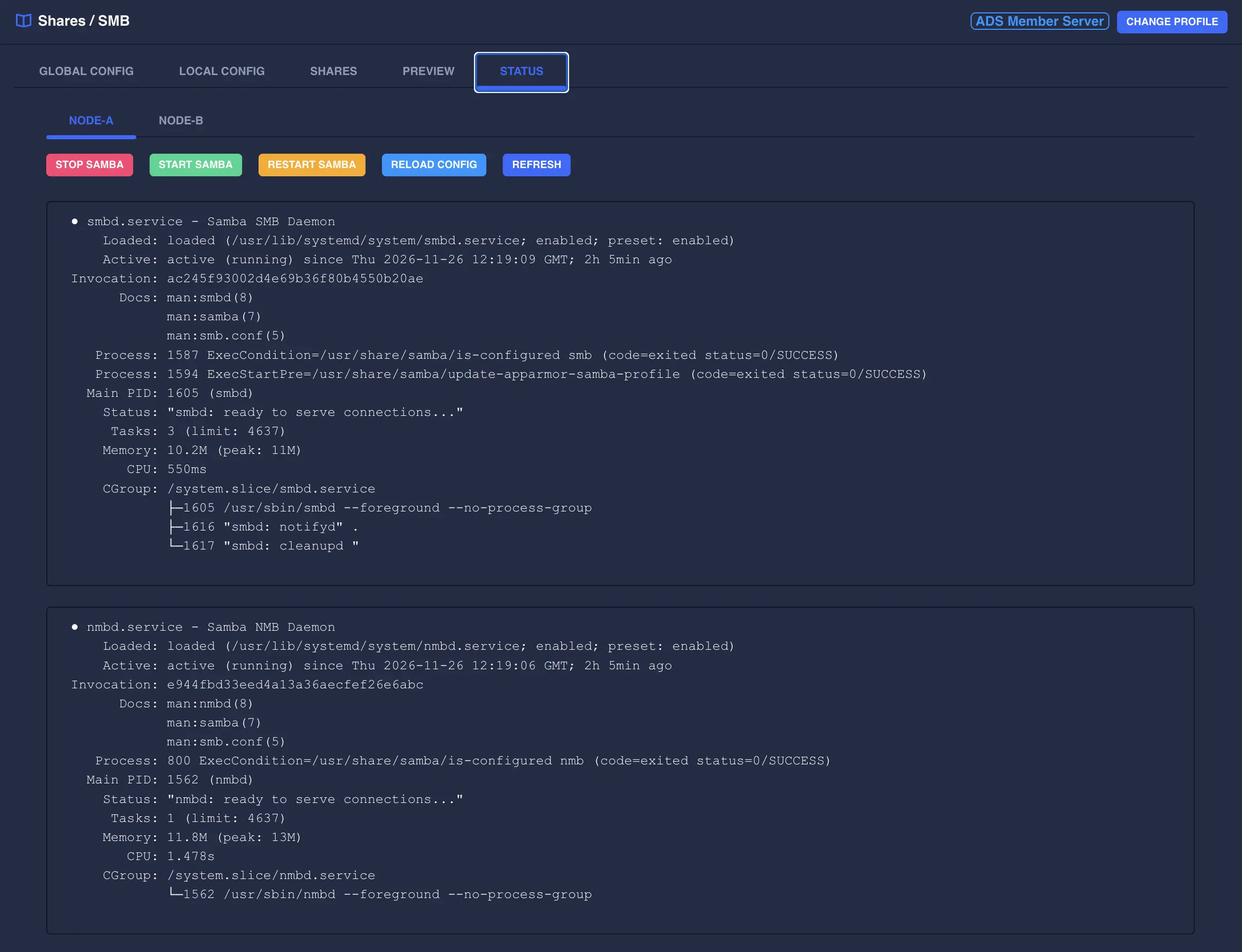
Create and manage Samba shares on clustered pools. Authentication can be local (cluster users) or Active Directory (ADS with recommended RID idmap for consistent UIDs/GIDs across nodes).
- Share definitions are synchronised across the cluster.
- Valid users, paths and advanced settings are controlled from the web interface.
- Samba reloads automatically when shares are added or changed.
- Local node-specific settings (for example unique NetBIOS names) are supported where required.
NFS shares
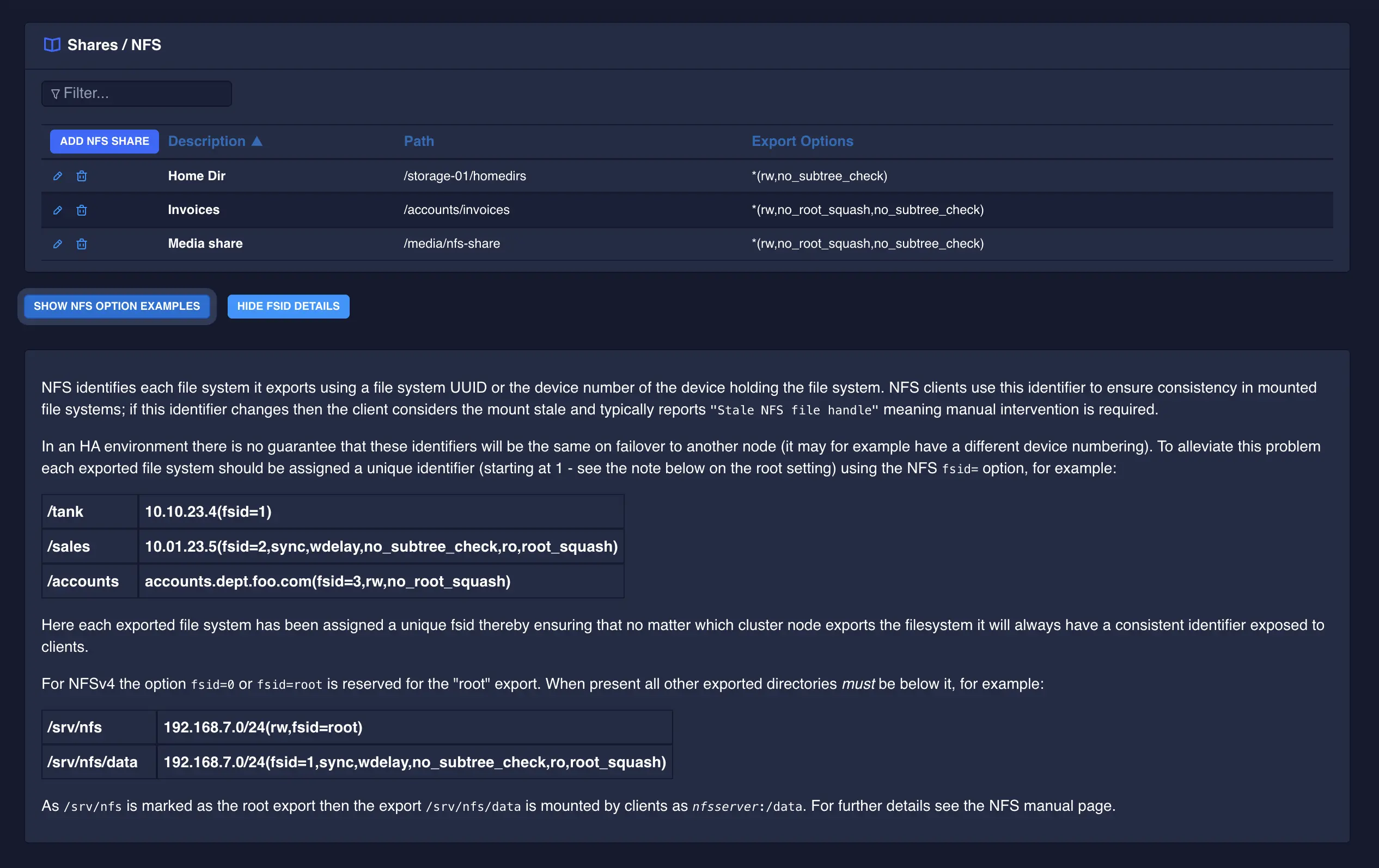
Export datasets from clustered ZFS pools using NFS. NFS is well suited to Linux and Unix clients, hypervisor datastores, and any environment that expects a standard file-level network mount.
- Export options are managed centrally and applied on the node that owns the pool.
- Existing /etc/exports entries can be imported.
- Suitable for Linux, Unix and hypervisor clients that expect a file-level mount.
- NFSv4 root export handling is supported.
iSCSI targets
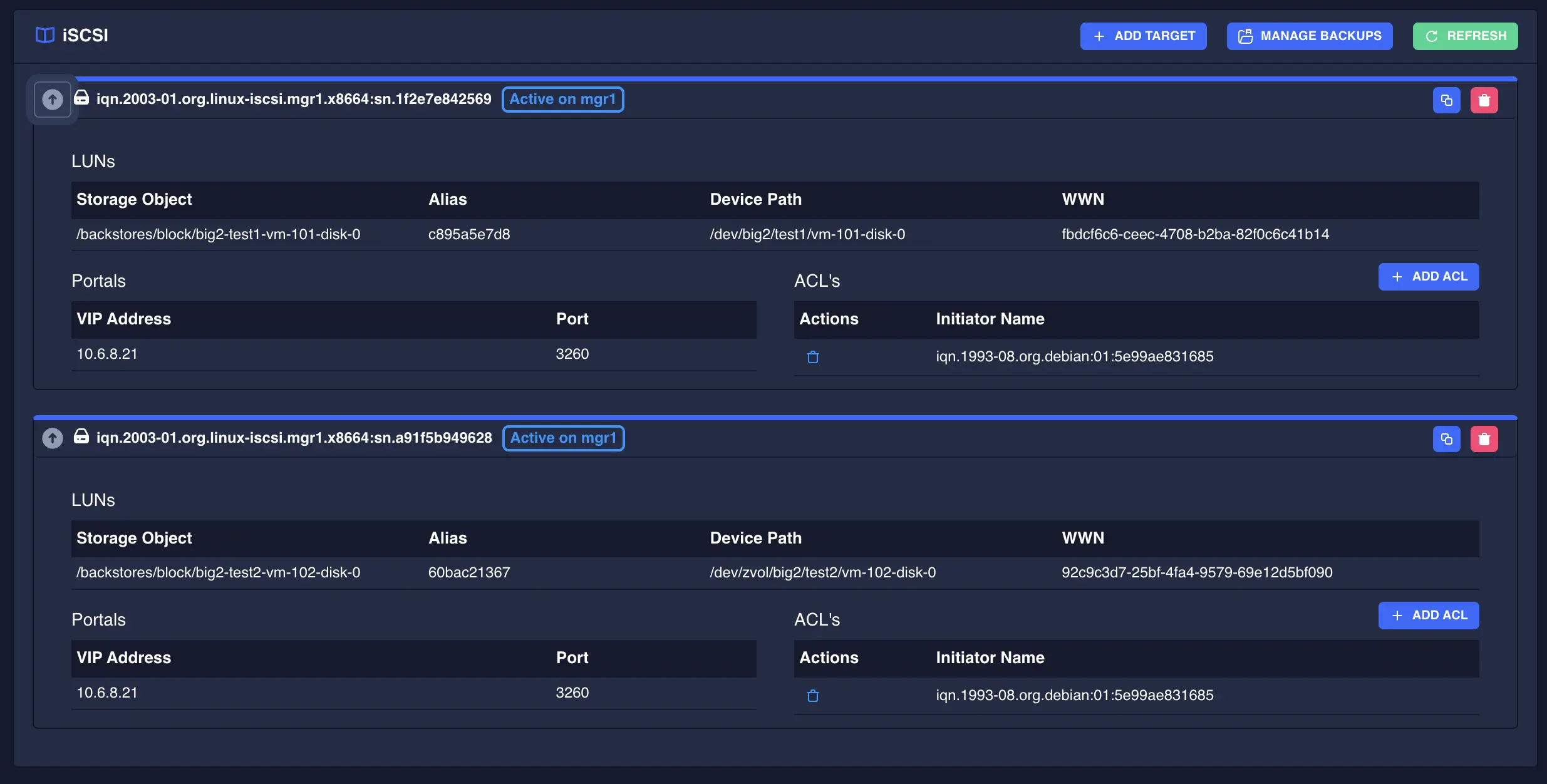
Present zvols as block storage via LIO. Traditional iSCSI targets (portal + LUN + ACLs) and Proxmox ZFS-over-iSCSI targets are both supported.
- Portals are bound to the service VIP so the target remains reachable after failover.
- ACLs control which initiators may access each target.
- Proxmox can create and manage its own zvols against the clustered pool; traditional targets use pre-created zvols.
- Existing LIO configurations can be imported and brought under cluster control.
Key benefits
- Single management interface for pools, datasets, users, groups and shares.
- No capacity-based licensing or artificial storage limits.
- Works with shared storage (dual-ported JBOD) or shared-nothing (ZFS send/receive) topologies.
- Manual or automatic failover; services can be moved for maintenance without client reconfiguration.
- Integrates with the same RSF-1 features used for Proxmox ZFS-over-iSCSI and general cluster control.
Suitable for
- File shares for mixed Windows, Linux and macOS clients.
- Hypervisor storage (Proxmox, others) via NFS or iSCSI.
- Application and database volumes that need a stable VIP and block or file access.
- Environments that want high availability without proprietary NAS appliances.
Ready to build a clustered NAS? Start a free trial or talk to us about your setup.